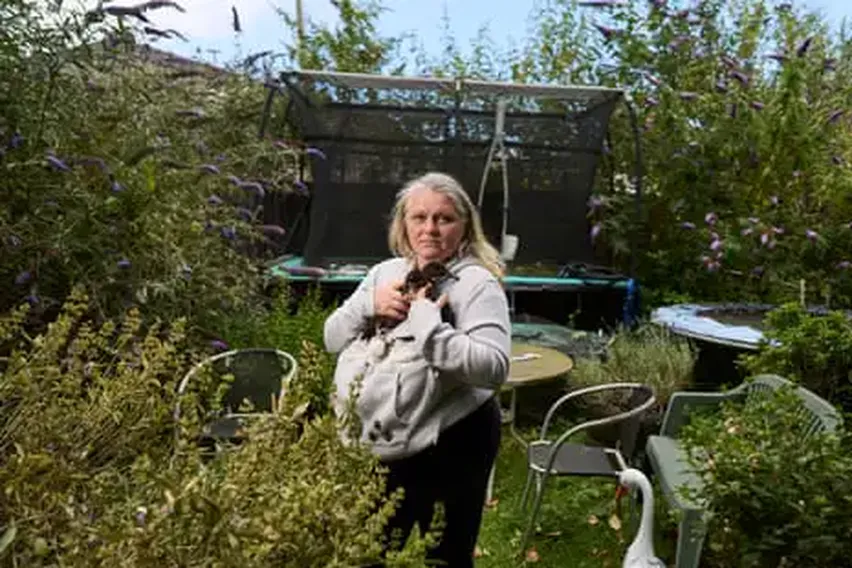
Last February, I got a call from a woman called Sam Hammond. We had been speaking on and off for a while over her growing concern that her garden could be affected by pollution from a nearby chemical plant.
That morning, Sam had been hand-delivered a letter from her council informing her that her pet ducks’ eggs, reared in her garden, were contaminated with Pfas chemicals.
“Are these chemicals in my blood?” she asked me at the time. Seven months later Sam has an answer to that question.
Pfas are a group of thousands of synthetic compounds known as “forever chemicals” because of their persistence in the environment.
In 2024, Wyre borough council and the Environment Agency launched an investigation into contamination of one type of Pfas – Pfoa, a group 1 carcinogen that was globally banned in 2020 – in the vicinity of the AGC Chemicals Europe factory in Thornton-Cleveleys, a town to the north of Blackpool. Pfoa was emitted in huge quantities from the AGC Chemicals factory up until 2012.
The level of Pfas in one of Sam’s duck eggs was so high that if she ate just one a week, it would exceed the European safe level 10 times over. Sam and her children had been eating these eggs every single day for decades.
The risk was increasingly clear, but residents did not yet know if the Pfas had entered their systems until last week when law firm Leigh Day, working with Dr Dave Megson, a forensic environmental scientist at Manchester Metropolitan University, and in association with Watershed Investigations, published the blood test results of 49 individuals who live around the factory.
In the UK, there is no guidance on what constitutes a safe level of Pfas in blood. However, in the US the guidelines state that if the sum of seven Pfas chemicals is above 20 ng/ml, there is an increased risk of adverse effects and that clinicians should consider more frequent, targeted health screenings.
The results showed that 70% of those tested in Thornton-Cleveleys had a combined Pfas level above 20 ng/ml.
Sam’s level is 25 ng/ml – putting her firmly in this high-risk category. But what is perhaps even more alarming is the level of Pfas in her son’s blood: 111 ng/ml.
“I feel quite sick about his results,” she said.
“My concern all along is what have we done to the kids. We moved here, chose this property and I feel guilty because I’ve exposed them to that, even though I know it’s not my fault.”
The results specifically revealed that nearly 70% of those tested had increased levels of Pfoa.
Pfoa exposure is linked to a range of serious illnesses and has been linked specifically to kidney cancer. In June, a government commissioned study found no higher-than-expected rates for most cancers but found that two areas – one south-east of the factory and one north of Blackpool – had recorded “higher-than-expected” rates of kidney cancer.
A detailed review found no evidence of a statistically significant excess of kidney cancer cases and no evidence of a cancer cluster or an environmental association, and argued it could be the result of random variation because of the small sample size, concluding: “No further cluster investigation is warranted at this stage.”
double quotation markHow can I get this out of my body? Who can help me? Where do I go from here?
These findings were immediately questioned by experts, who advised further investigations. Megson, who was not involved in the study, described this conclusion as being “very contradictory” and said it “seems to downplay the findings rather than assess it objectively … Personally, I fear that this data is giving us strong evidence that … significant harm has already been caused.”
One woman, who asked to remain anonymous, has a Pfas level of 436 ng/ml.
She recently had a tumour removed from her back and is now left questioning whether her persistent health problems may be linked to this chemical exposure.
“I thought I was just unlucky, but when I found out that result I thought it must have something to do with it,” she said.
While the test result has given her some answers, it has left her with even more questions.
“How can I get this out of my body? Who can help me? Where do I go from here? I just want this out,” she said.
In the UK there is no clear guidance on what to do if you have high levels of Pfas in your blood. However, the council has advised residents within a 1km radius of the factory to wash and peel home-grown produce and not to eat eggs from locally reared birds.
Because of the potential risks to human health, the council has also announced plans to shut down two allotments close to the factory.
For the past five years Alan Hodson has had a plot on one of the allotments that borders the AGC Chemicals site. The allotment was his sanctuary. But last year he received a hand-delivered letter informing him that his beetroot contained the highest level of Pfoa of all of the products tested.
“I just think of all that time I spent here – I could’ve been doing something else. It’s just wasted time,” he said when I visited him earlier this year. Alan has now found out his blood contains 43 ng/ml of Pfas.
“You get an allotment and you grow homegrown veg to be more healthy and then all of a sudden you’re told it’s polluted. I’m worried but you’ve just got to crack on. If you dwell on it it takes over your life.”
Following the recent news of AGC Chemicals planned closure, Megson is calling on central government to step in to provide more support to residents.
“That is what has happened across the globe for the last 50 years when potential chemical pollution disasters like this are uncovered. In other places there has been swift widespread biomonitoring offered to residents. This helps clearly establish how localised the problem is,” he said.
A spokesperson for AGC Chemicals Europe, Ltd. said: “We are aware of the recent blood testing initiative, and we understand the concerns this may have caused amongst local residents. Whilst the parties conducting these tests have chosen not to share their findings and data with us, we would emphasise that the UK government’s position is clear: PFAS blood testing does not predict future health problems and can sometimes create unnecessary concern. For these reasons PFAS biomonitoring is not currently recommended through the NHS or private blood tests.
“The Hillhouse site and surrounding area has been dedicated to industrial chemical manufacturing for well over a century – long before AGC Chemicals Europe, Ltd was established – and a wide variety of historical users have operated on the site. Since the wider multi-agency investigation is still ongoing and no formal determination of land contamination has been made under part 2A of the Environmental Protection Act, we cannot speculate on future outcomes or next steps.
“AGC Chemicals Europe, Ltd has been part of the Thornton Cleveleys’ community since 1999. The health, wellbeing and safety of our employees and the local community remain our priority.”
The government has been contacted for comment.